Friday, December 17, 2010

Inspiration Galore (INK Conference)

Last weekend was one of virtual inspiration. Just a few days before it happened, I found out that TEDIndia was happening again, but it had been restructured to be called the INK conference (in association with TED) that would happen on an annual basis in India (TEDIndia was a one-time thing).

If you don’t know about TED, let me introduce you. It’s a treasure vault of inspiration. TED spreads ideas. It started off as a single conference that has exploded globally to be many conferences. Inspirational folks from all fields are given 6 to 18 minutes to share their work, story and/or idea with the world. While I don’t have a bucket list per say, attending a TED conference is most definitely something I want to do one day.

Anyways, bringing it back to INK. They live streamed one session each day, which was fantastic to watch and thanks to social media like twitter I could get the take-away messages from the other talks that happened over the three days. Some of the best talks are going to be on the TED website, but here are some of the take-aways and stories from the three days (compiled from tweets). You can find more information on the speakers on the INK Conference website.

Side: For Avatar fans, James Cameron is coming out with Avatar that will be going to a new biome – the ocean.

DAY 1:

A great write-up on Day 1 is on the TED Blog here - http://blog.ted.com/2010/12/10/the-ink-conference-day-1/

DAY 2:

Alexander Tsiaris: “When we're born, we're given a pristine cardiovascular system. Then, we screw it up.” He shares stories about wellness to communicate its importance because “Data does not speak to you. Pie Charts never changed anyone's life - story speaks”

Deepti Naval (after visiting and writing about mental institutions): I could never look at life in the same way again. She gave an intense reading of her poetry, capturing the tortured life of a mentally ill woman.

Simon Lewis: “I believe that we can all rise and shine.” (He gave a talk that started with his almost life-ending accident to the importance of consciousness to science and healing). He explains the experimental sensor-based technology that allows him to walk today and raises awareness about head injuries and ways to recover from them.

Sophie Morgan: Her life changed when she ended up in a wheelchair. Changed, but didn't end. She designed The Mannequal to incorporate wheelchairs in shop windows because disabled girls like fashion too.

Deepak Chopra: proposes that consciousness creates reality. Ultimately, there is only one kind of healing -- the holiness that we experience when we return to our ground state.

Nancy Duarte: You have the power to change the world. It only takes a single idea. I'm really passionate about presentations, brilliant ideas can be forgotten just because of how they're presented. (Great talk on how to make effective presentations)

Anand Kumar begins with the story of Santosh Kumar, a rural Indian who did not have access to formal education but studied on his own. Anand accepted Santosh Kumar to his "Super 30" program. Santosh is now a scientist in Belgium.

George Mathew: When people make music together, they have to listen to each other -- that's an important lesson for young people.

When being beaten in a mugging, his metronome fell out of his pocket. They began asking questions -- mugging became a music lesson.

Luis Dias: Our children are talented. All they need is a chance. Let us give it to them.

Tom Wujec: 3 tech trends might change everything: Digitized reality, infinite computing and rapid fabrication. Once the 3D printer can replicate itself we will definitively have the democratization of design. When we're able to build anything, what will we build?

Corey Bridges: I think the most important thing the Internet enables is collaboration

Sunitha Krishnan: Only when the most excluded, rejected, isolated are included will we have a world that will be a better place for all.

Her story post TEDIndia talk - Google grant led to led to construction of a school, youth home, adult home, hospital. Her Sunitha shelter has been attacked multiple times by mobs, her life attacked. Today the challenge is how to build a team of people who will be committed under such conditions?

C Mallesham innovated an automatic loom to revive the dying tradition of Pochampally silk sari weaving (took him 5 years, he was told only educated engineers could design something like this).

Mussaret Zaidi: Hygiene hypothesis: lack of exposure to bacteria at a young age may hinder immune development (proven to be true). Food policy should take into account local conditions, consider human/animal/environmental health

Ugesh Sarcar: His father, also a magician, told him magic is all about psychology

Mark Koska: Contaminations from injections kill twice as many people as malaria worldwide. He invented a 5-cent syringe that breaks if you try to reuse it.

Ashwini Akkunji started out by running after cattle in her village in Karnataka. Ashwini Akkunji was supported by her father in becoming an athlete, but faced many hurdles of health, isolation, community disapproval. She went on to become an Commonwealth champion.

DAY 3

Alexander Tsiaras’ advice for the young (but really all): You are only limited by your imagination. The possibilities are endless.

Raghava KK: We need to pop our bubbles and continue to reinvent ourselves. My learning is all about unlearning. Everything we do is art. The way I live my life is art.

His favorite new art project - an iPad app that lets you play with and personalize his illustrations.

John Henry Harris: Play hard, work better. When we play, we're open to creativity. At Lego, we have co-creation sessions with kids. It's really about what the children can teach us. True beauty often lies with the simplest things.

He gave each participant a bag of lego and asked them to build a duck in 30s. 30s led to many possibilities à simple way to share that creativity is inherent in us.

Sharada Srinivasan: The striving for perfection in dance is the same as the craftsman striving to create their perfect project.

Arvind Gupta: Often one doesn't know what one wants to do. Sometimes, it's good enough to know what one doesn't want to do. Children want to make things, they want to do things. Science must reach the most oppressed, most marginalized children.

Help spread science and toys to all. Arvind wants others to use his design. See all the toys he makes from nothing and get instructions on how you can do the same: http://ow.ly/3nMeP)

Philippe Starck (Very humourous and wearing crazy pants): Everything is organic, even me. When you produce, you have the responsibility to keep your product clean. Anything extra will boomerang and kill you.

Shivam Sai Gupta (India’s youngest animator) – I believe creativity is born from pain and suffering. And, creativity can solve any problem.

Lynda Barry (Hilarious talk) – Starts with how her grandmother is Filipino, which she, unlike Americans, is not crazy. What is an image? It's spontaneous and feels somehow alive. The image world is so much more than art, it's all around you. The thing that scares me about technology is that reduces eye contact between children and parents.

Matt Groening (another hilarious talk): He began with wisdom from the Simpsons and gave insight into what each character was based off of. His dad told him "Matt, you can't draw, so don’t try to make your living as a cartoonist.” Ultimate payback: naming a character (Homer) after him.

Rives did a funny wrap-up of the conference, poking fun at attendees.

KUDOS to the INK team. How can I attend next year ;)

Thursday, November 04, 2010

Lighting Lamps - Jyot se Jyot

As I light oil lamps, one from another, alongside millions around the world, a song and story spring to mind.

Jyot Se Jyot Jalate Chalo
Prem Ki Ganga Bahate Chalo
Raah Mein Aaye Jo Deen Dukhi
Sab Ko Gale Se Lagate Chalo
My own loose translation

As you go along light another's lamp with your own
Let the river of love flow as you go
If you meet anyone with sorrow along your way
Embrace him as you go

-----

I am reminded of a story I read long ago, yet cannot find. Here is it paraphrased (which I know is not as beautiful as the original).

A man made the long journey to the sacred fire. He crossed rivers and went over mountains. With his candle lit, he began the journey home. Along the way, he came across a women with an unlit lamp, who asked him to light her lamp with his own. Not thinking of the pains he took to light his lamp, he put his candle to hers. As he continued, the rains came down, extinguishing his light. But he had shared his light with another. So instead of having to take the long journey to the fire, he made his way back to the woman and lit his lamp from hers.

---

As you light your lamp, embrace the nature of its fire that does not diminish when shared with others.

Jyot se jyot jalate chalo.

Friday, August 13, 2010

Gratitude for Ice Cream and Electricity and everything in between

Today the topic of our conversation veered from a question about how patriotic Jana Mana is to everyone's favourite - Ice cream. Well, actually the importing of ice from Britain to India. (Did you know that ice was imported? that too over ships that took weeks to reach their destination?) The reason for the import? British officials wanted ice cream.

How was ice cream invented? There are many stories. Wiki would probably give you more insight, but the story that was shared was how after much struggle, someone got the idea to add salt to the ice to enable the creation of ice cream.

It got me thinking. Everything in the world around us, was at some point someone's invention. A random thought or idea that took time and patience to develop. Edison didn't invent the lightbulb in a day. So many people died in the process of creating airplanes. And what about our computers and phones? The things we consume on daily basis where the result of someone's idea, someone's perseverance and dedication (in many cases, that of many people).

As our conversation moved from ice cream to airplanes, I was filled with gratitude for all those that came before us, for giving us the many luxuries and little things that we take for granted, yet have a place in our lives. In that gratitude, I was reminded yet again of how we are connected to not only the world we live in at present, but that which came before us and that which is to come.

Monday, June 14, 2010

Gratefully Overwhelmed

[Old entry that I never got around to posting]

The last stop on Tabla Ecstasy's North America tour was Toronto.  My family and family friends did a fantastic job organizing the show.  For most, it was the first time they were going to hear me (or Tabla Ecstasy) perform.  Though still an amateur, I had the honour of opening for my gurubhais.  But before that, I had to get on stage and introduce my world, beginning with Guruji.  As I looked out at the 500+ audience and started speaking, I choked.  Normally, I am very comfortable on stage, emceeing is something I've been doing since childhood. This wasn't supposed to be difficult.  Without notice, my eyes had filled up with tears and I was at a loss of words.   I was overwhelmed with gratitude.   Many of the those who sat in front of me had seen me grow up in front of them and today they were all there to show their support for what I was doing and be apart of my world, even if it was only for a few hours.  Even as I sit here recounting the moment, I am overcome with emotion, reminded yet again of the countless hidden threads of love that give me strength in my journey.  I say it time and time again and even though it doesn't seem sufficient.  Thank you.

The whole evening is one that I will never be able to forget.   We all felt the outpouring of sincere blessings and good wishes.  The energy that was cultivated that night was something beyond words.

My performance that night was not my best, as I had been battling the flu all week, but nonetheless here is a clip.

[youtube=http://www.youtube.com/watch?v=dRRmEBwg_eQ]

Friday, April 16, 2010

On the Road

Touring is an experience. It's been great to reconnect with so many friends over the last few weeks. We've really been all over the place, but haven't at the same time in comparison to what it is going to be like next time around (this time its been VA, NC, SC, GA, NY, NJ, PA and CA, while next time its going to be a more comprehensive US tour).

There have been many highs. One of them being the incredible response we are getting show after show. To see the years of practice that the Tabla Ecstasy artists have done being appreciated and to see the impact they are having on their listeners has been wonderful. The number of well-wishers that this group is just growing and growing. One of the responsibilities I have on the road is to get feedback from the audience after the show and many many times I have been so overwhelmed by the true heartfelt wishes and prayers for the success that people are giving for the group. I am reminded time and time again how fortunate I am to be apart of this wonderful family and to have Guruji in my life.

This week is our last week in the US. We have shows in Albany (tonight), Manhattan (April 17th) and Princeton (Sunday). Then we head North to Canada, where I have the privilege of opening for the group during our Toronto show.

Friday, April 02, 2010

Natural Medicines (Homeopathy, Ayurveda, Etc)

Blessings are important and I have been fortunate to receive a lot of these. “Bless you” was something I heard quite a lot, particularly due to the regularity of my sneezing. It wasn’t just regularity but all the number of times I sneezed in a row. My sister made it a game to see how many times I would sneeze, I believe my record was something around 25 sneezes in a row. If you haven’t guessed it my now, I had health issues growing up. I was the one with the weak immune system. I was allergic to everything on the allergy chart list except for oranges. When I got sick, the cold and fever would go away in a few days, but the heavy nasal congestion would stay for weeks afterwards. I would be carrying around a toilet paper roll and cream for my chapped nose.

Things improved as I got older, California weather definitely helped. India did not. The dust and pollution severely aggravated my allergies and I was continually sick or had nasal congestion. When I started tabla, this was very problematic because I would practice for a few minutes and would have to stop to blow my nose, which disrupted any sort of continuity I would try to build. After recovering from one particularly severe bout of sickness, where I went on antibiotics and the ENT doctor gave me local steroids for my nose, it was time to find a permanent solution. The ENT doctor was of no help when I asked him for a long term preventative solution, offering only reactive solutions like the local steroids after the next infection sets in. There had to be a better solution. So off I went. I ended up going to 3 homeopathy doctors and one ayurvedic doctor. Each doctor was HIGHLY recommended by people who swore by them. The following advice is based on my personal experiences and that of close friends.

  1. Natural medicines boost your body’s long term immunity, when possible avoid allopathic medicines. I grew up on allopathic medication. It was a childhood full of Tylenol, antibiotics, Benadryl and more. One of gurubhais didn’t. He grew up on natural medicines, even if it meant that he was sick for a day or two longer than those who took allopathic medication. (I am speaking in reference to the common cold and flu, not life-threatening or serious diseases). Today, he is one of the healthiest people I know. No allergies and hardle ever gets even a minor cold. Allopathic medicines, especially at a young age, make your body dependent on chemicals to fight off infection instead of allowing your body to develop natural defenses. I can see how it would be more difficult for a mother to see her child suffer for longer as natural treatment may result in a longer recovery, but in the long terms its better for your child.
  2. Even a highly recommended doctor might not be able to solve your problem, but that doesn’t mean they are not good doctors. While most ayurvedic and homeopathy doctors will tell you that they can solve all of your health problems, whether it is poor circulation, allergies or weight loss, they can’t. Even if two doctors practice the same form of medicine (ayurveda, homeopathy, bach flower essences, etc), each doctor has their own method of diagnosis (from the ones I went to, some read your pulse, another used a magnet to read vibrations, another asked A LOT of questions) and treatment. Each usually has certain things that they are very good at treating and other things for which they are not effective. You may have to go to more than one doctor before you find one that works. Going to a recommended doctor is a good place to start, but don’t get discouraged if you don’t see results from them.
  3. So how do you tell if their medicine is working? Simple rule of thumb - If you don’t see a marked improvement (at least 10 –20%) improvement in a week to 10 days, try something different. Natural treatment takes time as they work on the root causes of health problems, not the symptoms, BUT if the doctor has correctly diagnosed and prescribed medicines (the two are different – correct diagnosis doesn’t not necessarily mean their medicine will be effective), you WILL see some improvement within a week. I tried some doctors for over a month or two before getting frustrated with the lack of improvement and trying someone new. When I finally found the right doctor for me, I saw a marked improvement within a few days. This has been the case for others as well. No improvement means the doctor might need to try a different approach. I’ve had to be a little aggressive in pushing to see some results or changing the approach if there is no success, but it saved the weeks or months that could have gone by.
  4. Find a doctor whose treatment works with your lifestyle. Lots of ayurvedic and homeopathy doctors will tell you that you can’t eat this, have to X medicine after X time, etc. If you can make that work for you, great! If you can’t, seek alternatives. One doctor gave me a very large list of things I could not eat over the course of the treatment. Reasonable restrictions are okay, but I knew that I would not be able to follow the degree of restrictions he had given, especially since I didn’t cook my own food. If you are not able to follow through on a treatment and its conditions, it’s better to be honest with the doctor. Decide upon something that is within your reach or you might end up not seeing results and will be unable to pinpoint why it’s not working. I don’t believe a doctor expects 100% adherence to restrictions, but only 50% can be detrimental.
  5. Follow your treatment through. Like I said above, natural treatment take time, but give long-term benefits as they address problems from their root rather than symptoms. It can be easy to “forget” about taking your medicines once you have experienced a 70- 80% improvement. Follow through and erase the problem completely from its root, otherwise it can re-emerge. If you don’t follow treatment through, at least go back for further treatment when you see some of the symptoms (even in a milder form) coming back.

Like I said at the start, I have experienced a huge improvement in health since finding my naturopathy doctor. When I went to her, my allergy index was over 1200 more than 3 times a healthy person’s allergy index. I can’t do much about the allergens – dust, pollution, smoke – but I improved my immunity. Instead of going from being functional to taking antibiotics within 1 day, the symptoms of an infection develop gradually over a period of 10 days. At the onset of symptoms, I can take booster medicines to fight off an infection and have successfully avoided antibiotics for over a year. Also seemingly unrelated problems have disappeared without direct treatment as they were all effects of the root cause.

So if you like me, had come to live with your allergies or other health conditions because there just didn’t seem to be a solution. There is hope. Give natural treatment a shot, there really isn’t much to lose.

PS. Anyone who have an allergy problem and is going to spend any time in Ahmedabad, email me and I’ll give you the info on my doctor who has successfully treated my allergies and those of many friends.

Thursday, April 01, 2010

On the Road

The first week of the Tabla Ecstasy US tour is now over and what a week its been. The guys (Tabla Ecstasy) have played 5 shows in 6 days and we've traveled from Jersey down to Georgia. Each show has been a different audience, but the response has been the same - immense appreciation. Its great to be on tour with this group and be able to hear them night after night and share that experience with so many people.

One of my personal highlights of this week has been watching as the members re-connect with family and friends here in the US (many of them are meeting after years). It's heartwarming to watch the interactions and see the smiles grow wider and wider after each meeting.

Now its time for my homecoming =). We head out to California tomorrow where I get to meet two of my closest friends after many years.

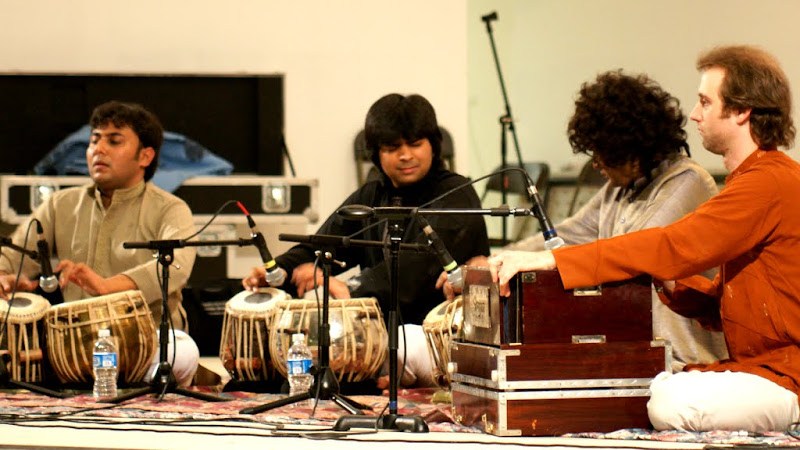
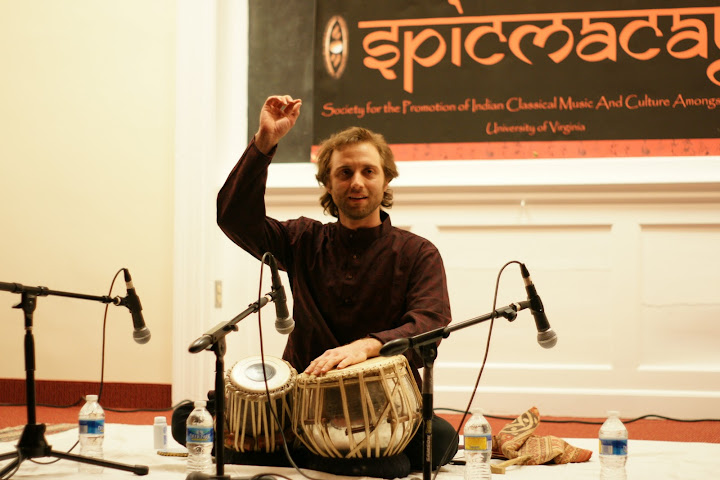
Here are some snaps from the programs so far:

Sahil is all smiles.

Tabla Ecstasy in Macon

Loren in his hometown of Charlottesville.

Monday, March 15, 2010

In the US

That's right. I'm back. Well not permanently. Tabla Ecstasy is touring the US, Canada and Dubai over the next 7 weeks and I go along with them as their groupie, MC and miscellaneous person. We have shows from New York down to Georgia and in SoCal. Below are our public program dates. If you're in the area, it'd be great to see you and come see what I'm apart of and will be doing sometime in the future =) More shows are being added.

More info on each show is on our website - www.rrmproductions.com or facebook

March 25 - Charlottesville, VA
March 27 - Charlotte, NC
March 28 - Macon, GA
April 2 - Ojai, CA
April 3 or 4 - Norco, CA
April 5 - April 19 based in New Jersey
April 10 - show in New Jersey
April 16 - Albany, NY
April 17 - NYC
April 24 - Toronto
April 28 - May 1 in Dubai

Friday, March 05, 2010

I AM CANADIAN

Note: I am bursting with happiness with the Olympics, how they went and being Canadian right now, so hence this really random post.

When this ad came out in 2000, it rallied the whole country. The ad talked about what we aren't, but really talked about what we are. It spurned countless versions, parodies and copycats. Everyone knew the words. It made Canadian swell with pride. While Canadian don't wear patriotism on their sleeve as much as their neighbours down south, there are a lot of things we stand for and are proud.

As a Canadian, it was a common occurrence to hear "You're just a little America." Its typical Canadian response to point out how we are different (and better). At the Olympics this year, I think the world understood what Canadians are about.

Over the last two weeks, even though I couldn't attend, I could feel the Canadian love and pride. There is something about the Olympics. For the last two Olympics, even though I can't see streaming live videos, I follow them through various news channel. Initially, there were the reports that this could be the worst Olympics ever with its long list of mishaps and obstacles. But Canada emerged from the underestimation to show it spirit. As the Vancouver Olympics unfolded, my Canadian spirit began to bubble over. Not because we set a record for gold medal count in Winter Olympics or won the hockey gold, but because of stories of Canadian hospitality, courage in the face of adversity and spirit and drive of the athletes.

The Vancouver Games are being considered by many as the best Winter Games from a spectator perspective. The hockey arena was packed with cheering fans for games between teams that were in no contention for medals. But it wasn't just hockey, there was immense public support for all events. Everyone from the media to people who attended are talking about how friendly and welcoming Canadians are. Its great to see that so many people go to experience the warmth that I have known for my whole life. I think it was summarized best at the closing ceremonies by the IOC president that he had "never seen a city embrace the Games in this way." I wouldn't say city, but country.

The spirit of Terry Fox was very much alive in the Olympics. Stories like that of Georgian team competing after such a loss, Rochette skating flawlessly in the wake of the her mother's death and the lesser known story of Majdic winning a medal with broken ribs and punctured lung demonstrate so many positive qualities that humans embody.

I love reading stories of different Olympians. Its inspirational to see people so focused and committed to excellence.

There are many against the Olympics, especially when you consider the amount of money and energy that goes into them. But there are also priceless moments of hope, inspiration, triumph that emerge from them. I don't know of many ways that you can get an entire nation together, coast to coast and around the world, in a swarm of red and white, aside from sports.

There is just something about the Olympics and it was made all the more special this time around because of the all-embracing atmosphere that was created.

Going to the Olympics in on my list, but I think its going to be hard to find one that would've been as awesome as Vancouver 2010.

Sunday, February 28, 2010

Pillars of Support in A Person's Pursuit for Excellence

When we cheer on our Olympian, beam with pride as they add a medal to our country's medal count, I wonder how many people truly comprehend the sweat, tears, hardwork and sheer dedication that it has taken for that athlete to get there. When we watch Cirque de Soleil, listen to the New York Philharmonic Orchestra or watch Sachin score a double century in one inning, how many people are really aware of what it took for each artist to get to that level.

We applaud greatness, celebrate another achievement, are entertained by another accomplishment, but how often do we become apart of the support system to create another legend?

Last year, when Inspire had come to Rhythm Riders, I was asked what an individual can do to support the future of Indian classical music. My answer was broader than the question - support someone who wants to achieve depth in the field. The field doesn't need to be Indian classical music. It could be sports, it could traditional arts, it could be any non-conventional field. I particularly say non-conventional, though it can be any field, because that is where it can be often more difficult to find support, especially if you are not apart of a community where that field is the norm (ie. someone coming from a family of wrestlers wanting to be a musician).

There are two parts of the journey to realizing your dreams. The first is having the courage to step towards to (and usually simultaneously rejecting the status quo on what you should do), the second is to stay on the path in the face of adversity (which includes lack of support and acceptance from society).

Taking the road that diverges societal expectations is a longer path. It takes vision, a firm belief and a lot of hard work to walk on. Many Olympians or artists many come from families with a background in their field, but for those, I have no doubt that the path must have been harder. I know I'll never forget those months that passed before my loved ones really began to full-heartedly support me. With their limited understanding of what I was doing and wanted to do, their concern and doubts were justified, but that did not make it easy for me, knowing that I was causing them pain. Today, I can walk more confidently on my path, knowing that I have so much love and support and it makes a huge difference.

Next time you see or experience excellence, take a moment to appreciate what the person has done to achieve those heights and more importantly, reach out and support someone you know in their own pursuit of excellence. It can mean the world to them.

Saturday, January 23, 2010

Control

Control. It is a the essential to success it seems. In any field or path, control is needed to achieve great heights. Discipline in one's actions, control over one's body and mind.

Our monkey mind jumps from here and there, the struggle is to bring it in our control, not be controlled by it. In dance, a good dancer distinguishes herself from the mediocre by having control over her body. Each movement, each limb follows her command. In tabla, I have the cursed blessing of speed. It doesn't take long for me to play something fast, but to play with precision requires control and even that speed should be of my doing not its own (think of the fast skater in Mighty Ducks). Its common to hear in the beginner class, "My finger (or arm) does that on its own," to which the response is always, "It's it your finger, control it."

One big struggle is for that control. The mind and body to work on your command.
Our mind revolts. Of course it does, it wants no master. Providing excuses and excuses, reasons for our defeat. But to gain that control means to first understand the monkeyiness of the body and mind. To recognize, its innate desire to move according to its own will not yours. With focus and determination, constant perseverance, its about making it your own, for one moment, then two, then three and five.

With that control, comes freedom. To execute one's vision and creativity to the fullest. The ability to move and play as one desires. Coupled with understanding, creativity finds its outlet, unhindered and expansive.

Thursday, January 21, 2010

Glimpse into Tabla Class

Many have wondered what tabla "class" is like for me and how Guruji teachs. Well, here is a little video that gives you a glimpse into a teaching session. I'm lucky because I get to sit in on these sessions a lot and as you'll see they are a lot of fun to be apart. Guruji is teaching some gurubhais different compositions from two gharanas that he has been formally trained in, namely Ajrada and Delhi. For those new to tabla, you'll hear the language of tabla (the fact that each stroke has its own name, along with its grammar, etc).


Thursday, January 14, 2010

Aal Izz Well

I saw 3 Idiots last week, basically after the entire town had already seen it. I was further motivated to write a post I’ve been thinking of writing for a long time that touches upon stuff in 3 Idiots. I generally don’t write about movies or books, but came to feel that the movie deserves a post of its own and the other post I’ll get around to.

After a serious drought of commercially successful Bollywood movies, 2009 really ended with a bang with Paa and 3 Idiots. All around whether it be in class or via facebook friends from around the world, everyone was talking about 3 Idiots. Even though, I don’t watch many Indians movies, even fewer in theatres (though movie watching and eating out are the top two recreational activities in Ahmedabad), I was determined to see this one in a theatre.

First I must acknowledge the awesome theatre. I saw it in the club class of Wide Angle, where they have fully reclining leather chairs. Very comfortable and if its a boring movie, you could easily sleep.

BUT 3 Idiots is not a movie to sleep through. Some said it was another Lago Raho Munnabhai, but I beg to differ. Yes it has its comedy, but not to the extent of Lago Raho. The second half of 3 Idiots actually has much less comedy than the first half and tear-jerking scenes (yes I am one of those people that cries in movies…)

I love the “message” of the movie. I am really glad to see a mainstream movie really talking about following one’s passion and not doing getavruti (acting like a donkey – aka doing whatever the mass does). I sincerely hope that Indian parents especially take this message to heart and are more open to allowing their children to do what they want, not what the parents think they should do. The film of course hit home with me as I’ve had to personally face the music about doing something very different, but that and more in another post.

Aamir Khan really has done it again. His films offer great variety and he is really doing a great job in creating entertaining and educational movies. Commercial Bollywood films can be a phenomenal outreach medium as they reach thousands around the world and he is using it as a social education tool.

Besides the film itself, you have to also give him kudos for the very unique marketing techniques used to promote the film. But the butt chairs in theatres, morning shows with free breakfast, “Where is Aamir Khan” game across India – he put fun into film promotion. The 3 Idiots quiz (CIT) on the Idiots Academy website reminded me of Brain Teasers I used to do as a kid. Want to see if you think outside the box? take the quiz =)

If you haven’t seen it, go see it.

If you need a push to go follow your dreams, go see it.

If you need help convincing your parents to support you as you follow your dreams, go see it with them.

Monday, January 11, 2010

Weeklong Indian Music Workshop in India!

Its a common thing to hear that people are interested in Indian music, want to understand it a but better, but don’t have the time to dedicate themselves to a full study of it. Here’s a great program for those interested in learning about Indian music. If you are already practice Indian music, its a way to deepen your understanding, learn from Guruji (Pandit Divyang Vakil), work with the world fusion group Taan and Rushi and jam with musicians from around the world for a week!
—————————–
Intrigued by Indian Music?
Want to learn how use Indian rhythm and melodies?
Explore the vast world of Indian music in India
Rhythm Riders invites you to
1 Week Indian Music Workshop in India
Aug 1 – 9, 2010 in Mount Abu, Rajasthan
*Experience India through its music amidst nature
*Explore Indian music, from its classical and folk to its contemporary forms
*Nightly jam sessions and concerts
*Learn to adapt Indian Music to your own music and instrument
*Special workshops on Indian percussion
*Special lectures with Tabla Guru Pandit Divyang Vakil
Final Concert Performance with World Fusion Group Taan
Open to musicians from around the world
instrumentalists and vocalists of all music genres welcome
Fees cover teaching, accomodations, local transportation, food and events.
**Airfare not included**
Register by April 30th, 2010.
Contact Rhythm Riders at manager@rrmproductions.com
or call (201) 467 4431
For information on Rhythm Riders, visit www.rrmproductions.com

Friday, December 11, 2009

Moving

For a while now, I've been pondering moving my blog from blogspot to wordpress and I've finally gotten around to doing it. The new blog is still in the works, but its where I'll now be posting.

You can now find me at rhythmicthoughts.wordpress.com. Hope to see you there

Thursday, November 26, 2009

Fruit and Coconut Quick Bread

Randomly, I'll decide to bake. I started baking because of the lack of good cookies and cakes in Ahmedabad (I would go to Subway to satisfy my cookie desire...). I don't get time to bake regularly, but when inspiration strikes, I have the basic ingredients around to try stuff out. Music and food really go hand in hand. Majority of great ustads were also incredible cooks. For me, its more about the baking than the cooking.

Anyways, I found a recipe for pomegranate quick bread, didn't have all the ingredients, so I made some substitutions and came out with this - pineapple, apple, pomegranate coconut quick bread (aka fruit and coconut quickbread). It turned out great. A bit on the dense and moist side, but still delicious. I got to use my loaf pan for the first time =) The best part, it's def much healthy than the majority of the stuff I bake.

Ingredients:
  • 2 cups sifted wheat flour
  • 2 tsp baking powder
  • 1/2 cup packed brown sugar
  • 1/2 tsp salt
  • 1 tsp vanilla extract
  • 1/2 cup pineapple juice
  • 1/2 cup shredded sweetened coconut
  • 1/2 pomegranate arils
  • 1/2 of cup unsweetened applesauce (I used freshly blended apples) + olive oil (I filled 3/4 of the 1/2 cup with applesauce then the rest with olive oil and ended up adding a little bit more applesauce and oil while mixing)
So the applesauce/oil portions are not exact. When mixing I thought there was not enough liquid, so added a bit more. When replacing oil with applesauce, you should keep some oil, which is what I was trying to do. Applesauce makes baked goods as does wheat flour (compared to all purpose), which would explain my denser quick bread. Also I think I might have added a bit too much applesauce/oil as my bread is a bit on the too moist side.

Directions:

1. Preheat oven to 180*C. Grease loaf pan - I sprayed mine using my new PAM baking spray.

2. Combine all ingredients in large mixing bowl; blend well.

3. Pour batter into loaf pan.

4. Bake for 45 minutes until top is firm and an inserted toothpick comes out clean. I baked mine for 53 min.

5. Allow loaf to cool before serving.

Great as a snack or for breakfast!

Sunday, November 15, 2009

Power of Education - Three Cups of Tea

International trips are a chance to read. What better way to pass layover time between flights.

Like I said in a previous post, education has been a recurring theme. After the incident with my cousins, I read Three Cups of Tea.

Very often we look for bandage solutions, not going to the root of a problem. This book beautifully speaks of how peace cannot be achieved through coercion and arms, but requires a long-term effort that is based on non-violence and co-operation. How? Through education. It is well-established that madrassas promoting extremist Islamic ideas are the breeding grounds for future Taliban fighters. For every one that is killed, two more appear in his place.

I initially tried to write my own "review" or take on the book, but words came out all jumbled together. I think the comments of Ahmed Rashid, the author of Taliban: Militant Islam and Oil in Central Asia and Descent Into Chaos succinctly summarize. If you're looking for a book to read, consider this one.

"Three Cups of Tea is beautifully written. It is also a critically important book at this time in history. The governments of Pakistan and Afghanistan are both failing their students on a massive scale. The work Mortenson is doing, providing the poorest students with a balanced education, is making them much more difficult for the extremist madrassas to recruit."

To add to his comments; sitting in the West, we can easily speak of removing terrorism, but Greg through his schools in actually doing that. In way that is sustainable in the long-term and heals old wounds and misconceptions.

This book perfectly highlights the power of education. It has the power of create a terrorist or a peace-maker.

Saturday, November 14, 2009

The Commercialization of Indian Classical Music

When the Muslim dynasties came to India, the cultural fabric of the country dramatically changed. Food, clothing, architecture were all influenced and of course, music as well. Many beautiful forms of classical music emerged from the confluence of Hindu and Muslim cultures, including the khayal style of singing (prior to this dhrupad was the mainstay of vocal music) and the introduction of tabla.

Alongside these changes, came the commercialization of music. Until that point, classical music was found only in the temples. Music and dance were for the Divine. To hear it, the king went to the temple, the musicians did not come to the court. It is under Muslim rule, that music made its way into the courts, both Hindu and Muslim courts, and the objectives of the musician began to shift.

Classical music has always been described as a yoga or path to the Divine. Through rigourous and tirelessly worship of sound, a musician purified their notes and their souls, seeking to please and ultimately merge with God. In the temples, the human audience was not of importance - they sat behind the musicians; it was for God that the musician played. The power and depth of these artists, the energy they emitted has become that of legend. Their music was their devotion.

When the musician shifted his stage to the court, the King became the focus. If a particularly type of harkat or musical pattern invoked appreciation (which was often in the form of a gold coin), then more were added to the next performance. The King was to be pleased for he was the lifeline for the artist. The goal became materialistic and coinciding with this change, the power of the music diminished.

A story of Akbar and Tansen explains the phenomenon quite aptly.

Tansen was a legendary singer and the court musician of King Akbar. His prowess is still spoken of today and his influence and contribution to Indian classical music far-reaching.

Once the king said to Tansen, "I believe you are the greatest singer in the world."

"No, my king, you are are mistaken. My music is nothing compared to that of my Guru Swami Haridas."

"I wish to hear him sing, call him to my court."

"I am afraid that is not possible. He does not travel outside of his place. If you wish to hear him, you shall have to travel with me on a long journey into the forest and that too, in the guise of a commoner."

It was an unusual condition, but Akbar was adamant to hear the person who Tansen claimed to be better than him.

The king ordered for a disguises and the two set off. They travelled far into the forest, ultimately coming near remote hut along a river.

"We shall wait here," Tansen said, asking the king to rest after the long journey.

Soon they hear the most divine notes from the direction of the hut and the king was lost in a state of ecstasy. Slowly he made his way towards the source and found himself in front of saintly man dressed in a simple dhoti outside the hut.

As the last notes faded and silence descended upon them, the potency of the music remained with Akbar.

The singer opened his eyes and greeted the visitors. "Welcome, O King of India. Your wish has been fulfilled." Swami Haridas recognized the king, despite his peasantry clothing.

The king began to offer much wealth and land to him as recognition for his art, but Swami Haridas would have nothing of it.

Taking leave of his guru, Tansen and Akbar made their way back to the city.

"You sing magnificently, but there really is no comparison to that of your Guru," Akbar pointed out.

"That is no surprise as there is one major difference between us. I sing for you, my guru sings for God. "

Saturday, November 07, 2009

Beauty and Need of non-English Languages

There was an article a few weeks back in the Times of India on foreigners taking intensive Gujarati language classes in order to be able to read Gandhi for themselves and better understand his philosophy. This came as no surprise.

As a Hindi, Gujarati and English speaker and a student of French and Spanish, I have gotten a chance to explore language. I recall cringing at the English subtitles during songs in Hindi movies as they destroyed the beauty and nuances of the original words. Compared to these other languages, English just does not have the depth, an observation that many multi-lingual friends agree with.

Learning philosophy from Guruji, I am often confronted with this topic. While Guruji is fluent in English, his native tongue is Gujarati (along with Hindi and Urdu). To make it easier for me, he often teaches in English. Being taught in English basically means that Guruji does a mental translation from Gujarati to English before speaking. Many times, as the topics and ideas are complex, I ask Guruji to speak in Gujarati as he can explain the subject with greater ease. When he does this, I am mentally translating the Gujarati into English before comprehending. My first language was Gujarati and to this day, I still speak in Gujarati with my parents, but my vocabulary has been limited to common Gujarati, not inclusive of many philosophical words. With my philosophy classes, my vocabulary has grown, but without a doubt, my learning, particularly in the initial period, was slowed by language.

There was an article on BBC a while back on native vs non-native English speakers. It spoke of how native English speakers could not easily understand the English of non-native English speakers, while non-native speakers easily understood the English of non-native speakers, regardless of their nationality or native language. The way native English speakers understand the English is very difficult from non-native speakers and I see this divide very clearly in India and during my philosophy classes.

Guruji is not a native English speaker. In fact, he never formally learnt English. In every day situations, English communication is never problematic. However, there are times during philosophy lectures when I have to ask him to repeat a sentence, as I get thrown off by the grammar or the use of a particular word. The mental process to understand the meaning of the sentence is brought to a small stop because of something that a non-native speaker would probably not even notice.

Just a few days ago, he was speaking to me about the basis of yoga. The topic made its way to the difference between science and spirituality. The difference can be understood through correct understanding of the words vishmay and akarshan. In a Gujarati-English dictionary they are given similar meanings - wonder or surprise. However, the words have very connotations. One has a spiritual dimension, one a physical. English, as far as I know, does not have two separate word that have the same surface meaning, but different nuances - driving home the idea yet again that the English language is limited, particularly in its spiritual/ metaphysical vocabulary.

Even ghazals and poetry in Indic language cannot be justly translated into English. Nor can they be readily understood by a non-native speaker without study. When you think of how the world is rapidly losing its languages and immigrant children around the world, particularly in English speaking countries, are failing to learn their native tongues, there is an important question to be raised about how much of the world's cultural heritage we are losing.

I have been blessed in this aspect. I was raised in a home where Gujarati was and still is spoken today; I was taught Gujarati by my grandmother and continued to study it and earn academic credit for it through high school and have the opportunity to visit and live in Gujarat where I can practice my Gujarati to this day. I still remember the praise my siblings and I would garner after trips to India on the quality of our Gujarati.

But this is still not enough. My reading skills are on par with a small child and my spelling errors know no bounds. I know that at some point in my journey to learn and explore philosophy, particularly Indian philosophy, I too will need to go the way of the foreigners learning Indic languages. If I want to be able to make my own interpretations and develop my own understanding without an intermediary, who to some degree always inserts their own bias or understanding, I will have to vigorously learn the language. Until then, there shall be some handicap, which I continue to try to overcome by expanding my vocabulary and fluency.

Tuesday, November 03, 2009

Importance of Education - Story 1

A re-occurring theme as of late has been the power of knowledge and the importance of education as a mechanism for change.

One of the most imprinting experiences I had in Canada this past trip came rather unexpectedly. Every time I come to Toronto, which is quite infrequent, my little cousins (now 7 -12), repeatedly request my parents to have me stay at their home, making their case well before my arrival. My schedule and their school schedule generally clash dramatically meaning that during the previous two trips, I only spent about an hour or two with them. This time, I had window of free time, which I decided to spend with them.

As I went to pick them up, I recalled a previous trip, where they had shown me their mini-fridge full of junk food. I remembered the horror I felt in learning of their excessive sugar consumption and decided to inquire more about their eating habits this time and talk to them about healthy eating.

When I arrived at their door to pick them up, I waited as the eldest handed my uncle a diagram depicting the order in which the layers of lasagna were to be placed so that we would have a correctly assembled meal for dinner. After everyone was seat-belted in the car, I asked them about what they ate. Knowing them to be picky eaters, I was super surprised at what I heard.

The three of them proceeded in turn to tell me about their fruit and vegetable rich diet and their lack of chocolate consumption over the last two years.

"Did you see our fruit bowl?", the youngest asks.

"Right now we have clementines, apples and bananas. Every day we have at least 2 fruits for dessert and another fruit for a snack," the middle one explains.

"Okay, so you eat healthy food for lunch and dinner, what about breakfast?"

"Well, we both eat Cherrios, but HE doesn't like them. He eats Fruit Loops and Lucky Charms," says the eldest matter-of-factly, referring to the middle brother.

"Fruit Loops! and Lucky Charms?!" I exclaim.

"We tell him they aren't good for him, but he doesn't listen. Actually in school, they asked us to bring in our cereal and we tested them for sugar levels and nutrients and those cereals were the worst," the youngest adds in.

That's when I realized where this all was coming from. Through school and the child care programs, my cousins were learning about healthy eating. When they were in daycare, I remember the meal plans they were sent home, but that is a standard practice. In the US in particular (I personally don't feel its as bad in Canada), general obesity and child obesity rates have been on the climb. One reason cited is the increased child consumption of junk food and processed food. I was encouraged to hear that the school system was fighting back by teaching kids about healthy eating. They not only taught children, but brought the discussion home to the parents during parent-teacher meetings and letters. I was getting a chance to see the results in person.

I joined the girls in explaining to my cousin why he shouldn't eat Fruit Loops and Lucky Charms. We got him to promise that he would stop eating them and all three decided to tell their dad about buying better alternatives instead (as they don't go cereal shopping with him).

As you can imagine, I had a huge smile on my face throughout that conversation with my cousins. But the best part was yet to come. For dinner, we had lasagna full of mixed vegetables including peas and carrots. Again, the topic of fruits and vegetables came up.

"You better finish all those vegetables, don't just eat the cheese," I told them.

"Give her more peas," the brother says pointing to the youngest, who happens to wear glasses. "They're good for her eyes."

Her reply was icing on the cake.

"You're wrong. Beta carotene is good for your eyes and carrots have them, not peas. And anyways, I took extra vegetables"